If you are a devops engineer and working in this role for more than three years then you can easily switch to highly paid mlops
Learn Data Science, Machine Learning and Artificial Intelligence
If you are a devops engineer and working in this role for more than three years then you can easily switch to highly paid mlops

Experiment tracking is very important steps when it comes to model deployment in production. When we make model ready for deployment we compare the performances of different recorded experiments and check which one is the optimal one. That is where it becomes very much important to understand how to do experiment tracking for different models trained under different machine learning frameworks. In this post I am explaining step by step approach to do experiment tracking for TensorFlow Based image classification model.
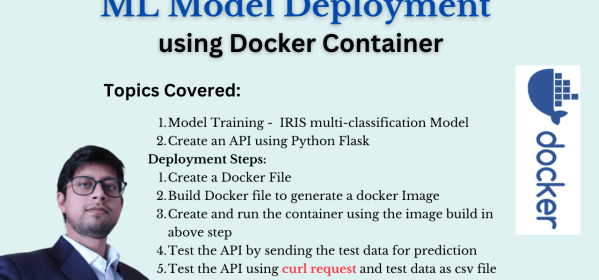
Model deployment is the next and very important steps once you finalized your model training and development. There are many methods available to deploy the models depending upon the type of serving. There are many serving methods like batch serving, online serving, real time serving or live streaming based serving. In this article I am going to explain one of the deployment mechanism which does online serving using APIs. So I will be explaining how to deploy models using Docker container and run them on production efficiently and reliably.
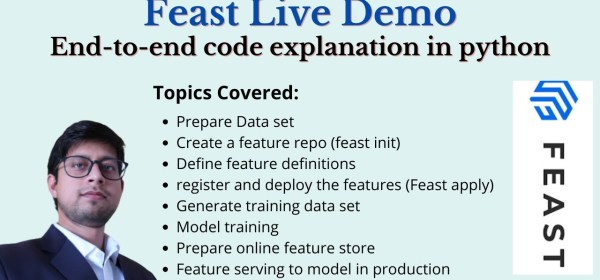
Feature store in machine learning is the concept to store features in both online and offline stores for model training and serving purposes. Feature store make sure to provide the consistency between the data used for model training and the data used during online serving to models. In other words, it guarantees that you’re serving the same data to models during training and prediction, eliminating training-prediction skew. Feast is one of the open source tools used for feature store.
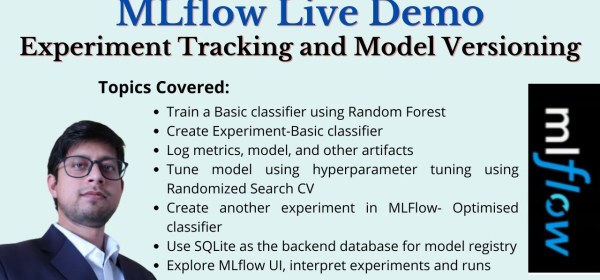
Experiment tracking is the process of recording all the important components such as hyper parameters, metrics, models and artifacts like plots PNG images, files etc. Experiment tracking helps to reproduce the old results by using the stored parameters.
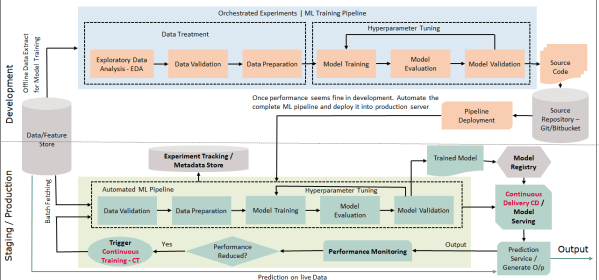
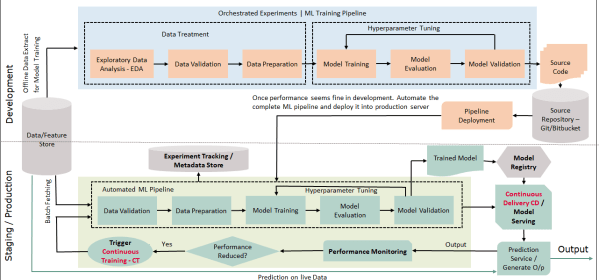
MLOps is the union of DevOps, machine learning, and data engineering. Built on DevOps’ existing approach, MLOps solutions are developed to increase re-usability, facilitate automation, manage data drift, model versioning, experiment tracking, continuous training and extract richer and consistent insights in a machine learning project.
 Data Science Duniya